Download Download Download Buy Now

What's a barcode symbology?

Each type of barcode is called a symbology. Each one has its own structure, its own data capacity, and its own usage — retail checkout, inventory tagging, shipping labels, app-store deeplinks, ID cards. Below is the full catalog of symbologies Barcode Producer generates.

Retail

The barcodes on retail products.

UPC and EAN scan at every grocery checkout, every big-box register, every convenience-store counter in the world. The retail symbologies, plus the coupon and country-prefix variants that fit alongside them.

UPC-A

UCC-12

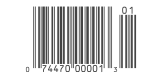
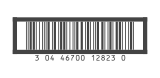
UPC-A sample

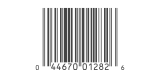
UPC-A barcodes appear on retail products sold in the United States and Canada. The symbology encodes a 12-digit Global Trade Identification Number (GTIN), along with an optional extension of 2 or 5 digits. UPC-A barcodes identify both the manufacturer and specific item of a product – they're scanned at retail checkout or in warehouses to identify the item.

Applications

  • Retail items

Also Known As

  • UCC-12

EAN-13

EAN/UCC-13, JAN-13, EAN-99

EAN-13 sample

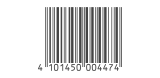
EAN-13 barcodes appear on retail products sold worldwide. This symbology encodes a 13-digit Global Trade Identification Number (GTIN) and an optional extension of 2 or 5 digits.

Applications

  • Worldwide retail

Also Known As

  • EAN/UCC-13
  • JAN-13
  • EAN-99

UPC-E

UPC-E sample

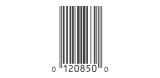
UPC-E is a special version of a UPC barcode used in the United States and Canada, designed to appear on smaller retail items. They're rarely used – only on products whose labels may be too small for a full-sized UPC-A barcodes.

Applications

  • Retail items (small items)

EAN-8

JAN-8

EAN-8 sample

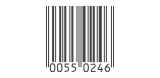
EAN-8 barcodes appear on smaller retail products sold worldwide. They are only used on products that may be too small for a full-size EAN-13.

Applications

  • Worldwide retail (small items)

Also Known As

  • JAN-8

BIPAD

BIPAD sample

BIPAD barcodes are used on magazines for inventory control and checkout. They represent a vendor ID, product ID ("BIPAD"), and issue number using the UPC-A symbology.

Applications

  • Magazines

GS1-128 Coupon

UCC EAN-128 Coupon

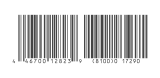
GS1-128 Coupon sample

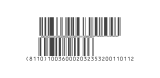
GS1-128 barcodes are historically used on coupons for retail items. This symbology combines a UPC-A barcode and a GS1-128 barcode. This type of barcode is typically no longer used, replaced with DataBar Coupons.

Applications

  • Old coupons

Also Known As

  • UCC EAN-128 Coupon

Books & Periodicals

Books, magazines, sheet music.

ISBN identifies every published book; ISSN every serialized magazine or journal; ISMN every printed musical score. Each one encoded into a retail-scannable barcode, with the optional 5-digit price add-on most retailers expect.

ISBN / Bookland EAN

Bookland EAN, Book Barcode

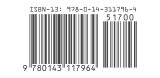
ISBN / Bookland EAN sample

An ISBN (International Standard Book Number) is a book identifier, used on books and eBooks. The ISBN barcode appears on the back and sometimes the copyright page of printed books, and on the back of audiobooks. An ISBN barcode establishes and identifies one title or edition of a title from one specific publisher and is unique to that edition. It allows for more efficient marketing by booksellers, libraries, universities, wholesalers and distributors.

Barcode Producer creates Bookland EAN barcodes, i.e. industry-standard barcodes that begin with the 978 or 979 prefix — referring to the country “Bookland” — and that are used internationally on books and book-related products.

Publishers purchase ISBNs from one of the over 160 ISBN Agencies worldwide. Publishers, e-book publishers, audio cassette and video producers, software producers and museums and associations with publishing programs can apply for an ISBN barcode.

The ISBN is ten digits long if assigned before 2007, and 13 digits long if assigned on or after 1 January 2007. The method of assigning an ISBN is nation-specific and varies between countries.

The ISBN symbology encodes an ISBN and an optional price extension.

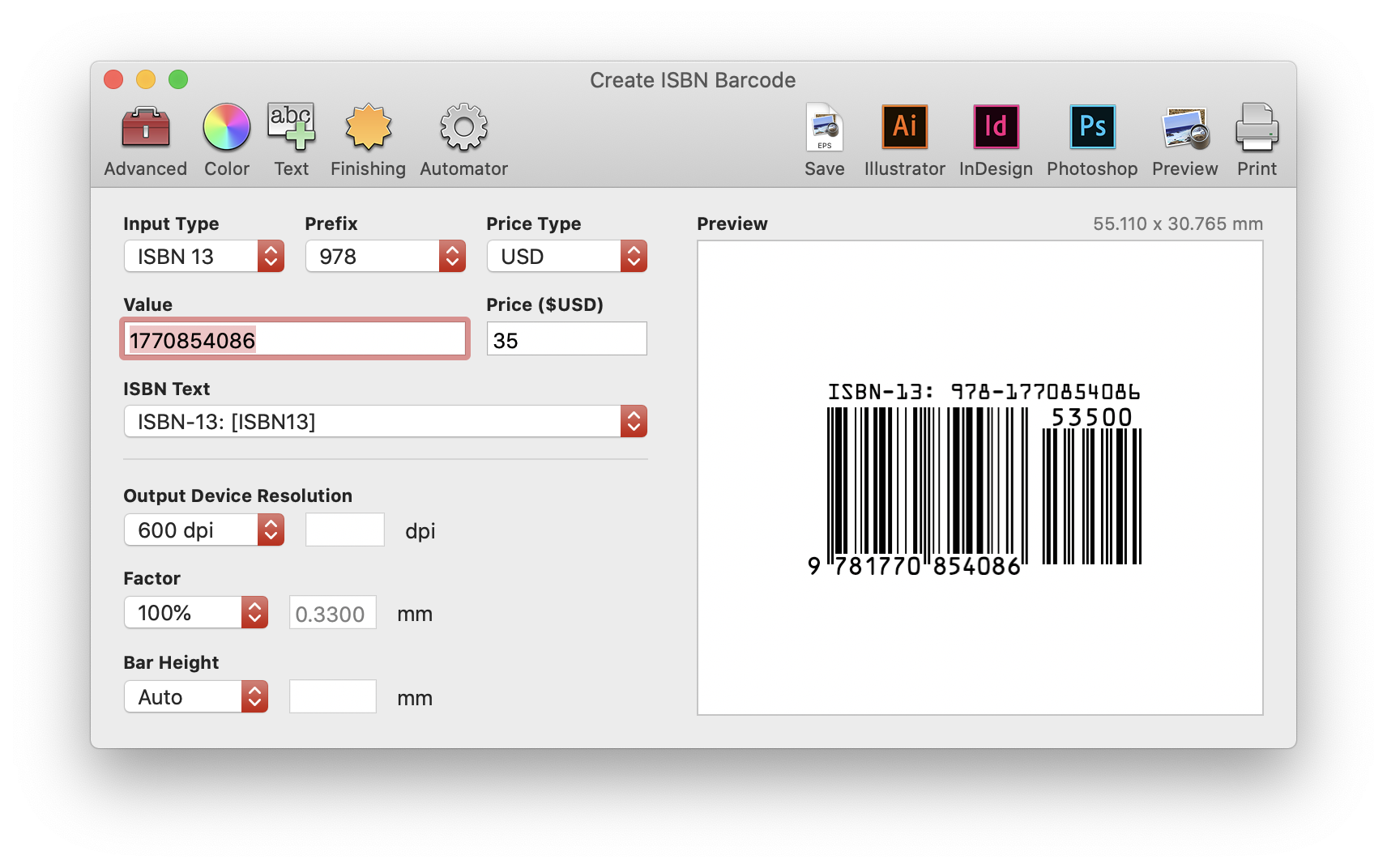
Barcode Producer creates perfect 10-digit ISBN and 13-digit ISBN barcodes on your Mac or PC with all the design and technical features you need – the 978 or 979 prefix, registration group, registrant, publication, checksum character or check digit, resolution, size factor, custom height, bar width reduction, and much more.

Barcode Producer lets you customize additional text, colors, and more – then send vector EPS or bitmap graphics to your desktop, printer, or to apps like Illustrator, Photoshop, Sketch, Word, and more. Download a free demo today.

Applications

  • Books
  • Audio books

Also Known As

  • Bookland EAN
  • Book Barcode

ISSN

ISSN sample

Barcode Producer generates perfect barcodes. Download a free demo

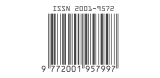
An ISSN is a 7-digit code (eight, with the check digit included) that identifies newspapers, journals, magazines and periodicals of all kinds and on all media — print and electronic. ISSN is the acronym for “International Standard Serial Number” and it identifies all continuing resources including some surprising ones, such as annual reports, websites, databases, collections, and blogs. In many countries, an ISSN is mandatory for all publications subject to the legal deposit.

Note that an ISSN does not tell you anything about the origin or contents of the publication, nor that it offers any kind of guarantee about the quality or validity of the contents.

An ISSN is associated with the publication title. Just as with ISBN codes, an ISSN must be registered at your country’s ISSN National Center or, lacking such a center where you live, at the ISSN International Centre.

You will always have the same ISSN for all issues of a periodical or a magazine, for CD-ROMs in a series, etc. The ISSN centers define a magazine as a continuing resource, which means it is published over time without a predetermined end. A serial publication, on the other hand, is an unfinished set of documents, published successively under the same title, for an undetermined period of time.

When the same publication is published on different media or in different languages, you must submit an application for distinct ISSNs for each medium or each linguistic edition. You must apply for a new ISSN when the publication’s medium changes and when the publication’s title changes.

Your local ISSN center may decide that you need to apply for a new ISSN when the publication merges with other titles, supplements are published, other editions are launched, and yet other cases that depend on your ISSN centre’s policy.

Using Barcode Producer to generate an ISSN

Barcode Producer encodes the ISSN in a GTIN-13 barcode which has a 977 country code in front. In Barcode Producer, you can easily enter the 7-digit ISSN number by typing it in the main field — a check digit is automatically calculated and added.

Barcode Producer structures the barcode as follows:

  • 977 prefix assigned to serial publications
  • Seven digits corresponding to the ISSN (without the hyphen and without the end check digit)
  • Two digits for variable information such as a price change (see hereafter)
  • Check digit calculated according to the modulo 10 formula.
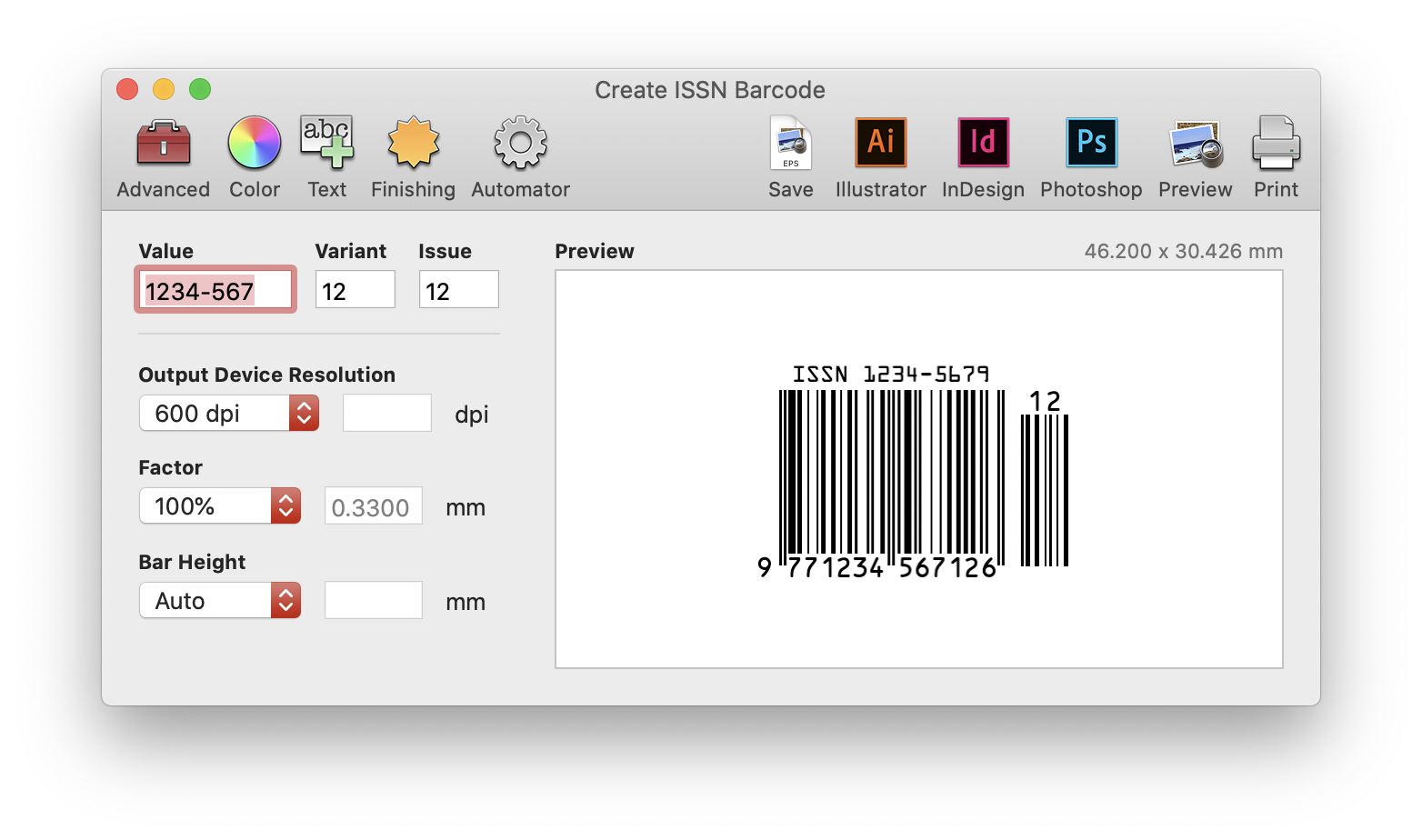
The variable information Barcode Producer allows you to enter in the Variant field indicates if a price change has occurred since the last coded issue. For any type of continuous publication except daily newspapers, these digits should be set at 00 when you start barcoding; for each price change that occurs, it should increase one digit at a time to 01, 02, etc.

Note that the field does not show the actual price of the publication but serves to alert the retailer that their records must be amended to ensure that the new price is recorded at checkout.

Special issues with a different cover price — e.g. Summer or Christmas editions — should have a price variant of 99 and then 98 and so on.

The Issue field holds a 2-digit issue number of the publication.

Daily newspapers follow a different add-on barcode policy:

  • Barcode Producer’s Issue field should in this case indicate the week of issue for the paper and remain the same throughout the week. The first digit of the Variant field should be used to indicate a price change starting from 0 and then going up to 1, 2, etc.
  • The second digit of the Variant field should then be used to indicate the day of the week, 1 for Monday through to 7 for Sunday.

Barcode Producer for Mac/PC creates perfect barcodes for retail packages, labels, books, packages, and everything else. Download a free demo today.

Applications

  • Magazines
  • Serialized publications
  • Scientific journals
ISMN

ISMN sample

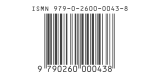
ISMN barcodes are used on printed music publications to represent an International Standard Music Number.

Applications

  • Music

Selling Online

What Amazon, Shopify, and Etsy ask for.

Online marketplaces require a GTIN on every product listing – usually UPC, EAN, or ISBN. QR Codes show up here too, often printed on packaging that links back to the product page.

ISBN / Bookland EAN

Bookland EAN, Book Barcode

ISBN / Bookland EAN sample

An ISBN (International Standard Book Number) is a book identifier, used on books and eBooks. The ISBN barcode appears on the back and sometimes the copyright page of printed books, and on the back of audiobooks. An ISBN barcode establishes and identifies one title or edition of a title from one specific publisher and is unique to that edition. It allows for more efficient marketing by booksellers, libraries, universities, wholesalers and distributors.

Barcode Producer creates Bookland EAN barcodes, i.e. industry-standard barcodes that begin with the 978 or 979 prefix — referring to the country “Bookland” — and that are used internationally on books and book-related products.

Publishers purchase ISBNs from one of the over 160 ISBN Agencies worldwide. Publishers, e-book publishers, audio cassette and video producers, software producers and museums and associations with publishing programs can apply for an ISBN barcode.

The ISBN is ten digits long if assigned before 2007, and 13 digits long if assigned on or after 1 January 2007. The method of assigning an ISBN is nation-specific and varies between countries.

The ISBN symbology encodes an ISBN and an optional price extension.

Barcode Producer creates perfect 10-digit ISBN and 13-digit ISBN barcodes on your Mac or PC with all the design and technical features you need – the 978 or 979 prefix, registration group, registrant, publication, checksum character or check digit, resolution, size factor, custom height, bar width reduction, and much more.

Barcode Producer lets you customize additional text, colors, and more – then send vector EPS or bitmap graphics to your desktop, printer, or to apps like Illustrator, Photoshop, Sketch, Word, and more. Download a free demo today.

Applications

  • Books
  • Audio books

Also Known As

  • Bookland EAN
  • Book Barcode

QR Code

Quick Response Code

QR Code sample

QR Code is a 2D symbology used with barcode scanners and camera phones. This symbology is often used to encode text, URLs, telephone numbers, and contact information.

Applications

  • URLs
  • Bulk content

Also Known As

  • Quick Response Code

UPC-A

UCC-12

UPC-A sample

UPC-A barcodes appear on retail products sold in the United States and Canada. The symbology encodes a 12-digit Global Trade Identification Number (GTIN), along with an optional extension of 2 or 5 digits. UPC-A barcodes identify both the manufacturer and specific item of a product – they're scanned at retail checkout or in warehouses to identify the item.

Applications

  • Retail items

Also Known As

  • UCC-12

EAN-13

EAN/UCC-13, JAN-13, EAN-99

EAN-13 sample

EAN-13 barcodes appear on retail products sold worldwide. This symbology encodes a 13-digit Global Trade Identification Number (GTIN) and an optional extension of 2 or 5 digits.

Applications

  • Worldwide retail

Also Known As

  • EAN/UCC-13
  • JAN-13
  • EAN-99

Inventory

Asset tags, internal SKUs, lab samples.

High-density linear barcodes for anywhere you need to encode arbitrary text or numbers. Code 128 handles alphanumeric, Code 39 is decades old and ubiquitous, Codabar and Interleaved 2 of 5 fill specific niches.

Code 128

Code 128 sample

Barcode Producer generates perfect barcodes. Download a free demo.

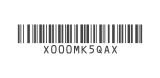
Code 128 is a high-density linear barcode symbology used for alphanumeric, variable length barcodes. It can encode all 128 characters of ASCII and, by use of an extension symbol (FNC4), the Latin-1 characters defined in ISO/IEC 8859-1. Code 128 is very popular and has been widely implemented in many applications where a relatively large amount of data must be encoded in a relatively small amount of space. It is a modern symbology and was invented 1981 by Computer Identics. Code 128 includes 108 symbols: 103 data symbols, 3 start symbols, and 2 stop symbols. It uses so-called subsets that each allow for different character type combinations.

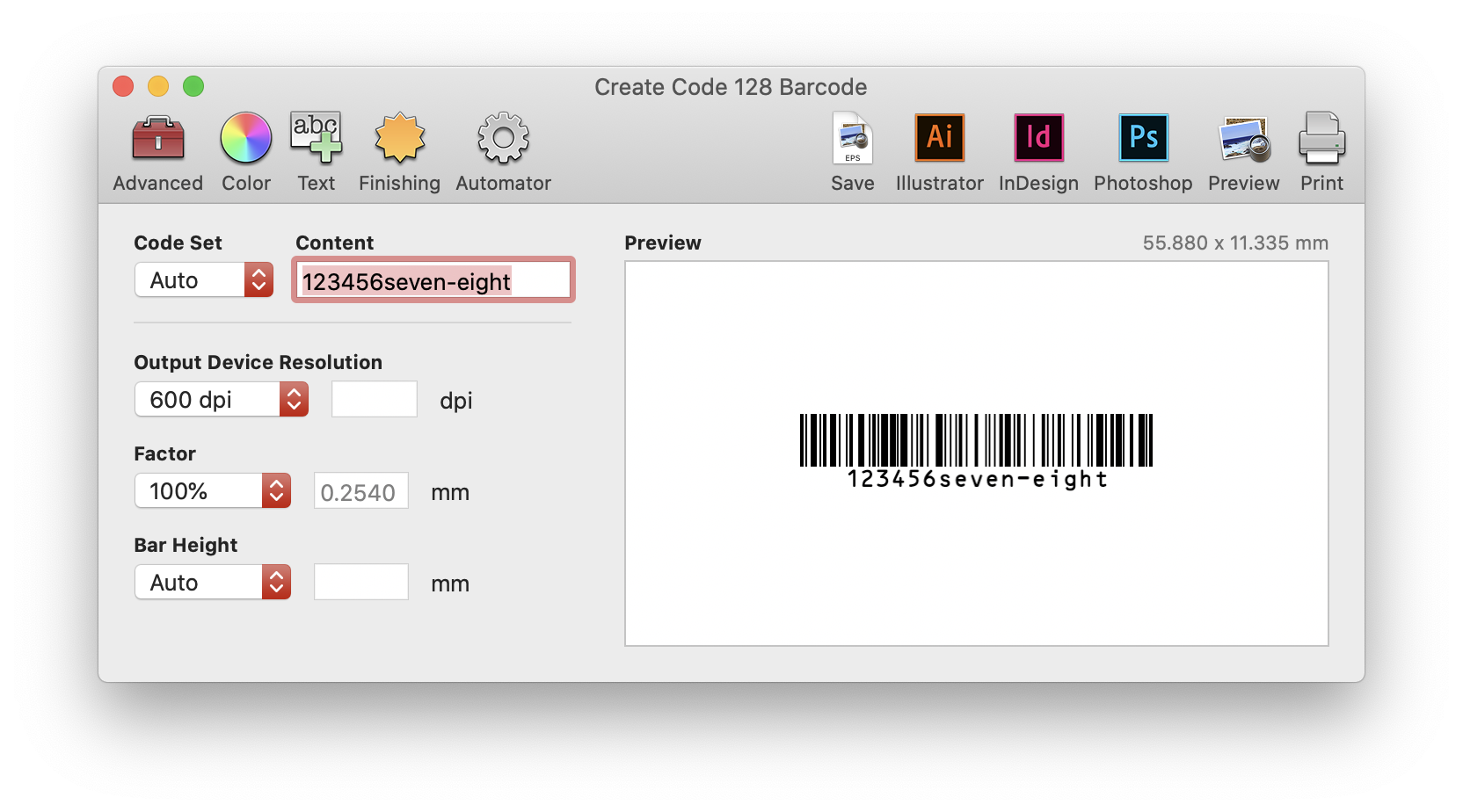
In Barcode Producer you can enter up to 60 characters for a Code 128 barcode. More data would make the barcode unreadable by most scanners. When you start entering data in Barcode Producer’s Code 128 panel, it analyzes your input and automatically chooses the best barcode subset with the highest data density. This is done by subset switching. You can also select a subset yourself from the Code Set popup menu.

In the latter case, there are three different internal subsets you can use:

  • Code 128A supports numbers, upper-case letters, and control characters, such as tab and new-line characters
  • Code 128B supports numbers, upper- and lower-case letters and some additional characters
  • Code 128C supports 2-digit numbers.
  • Code 128 includes verification protection both via a checksum digit and byte parity checking. The built-in checksum digit is based on a Modulo 103 calculation. Barcode Producer automatically generates the check digit, but doesn’t print it in the human-readable text as the standard dictates. Scanners, however, do check it when reading a code; they do not output it to connected systems.
  • Code 128 uses four types of bar size, so printers with high print quality are required. This barcode is not suitable for printing with dot matrix printers, low-quality inkjet printers and flexography on corrugated cardboard.
  • Note: GS1-128 makes use of the characteristics of Code 128 and is currently used in many industrial applications. With GS1-128, various data can be stored in the barcode, including a product manufacturing date, weight, size, lot number, destination, bank account, etc.

Barcode Producer for Mac/PC creates perfect barcodes for retail packages, labels, books, packages, and everything else. Download a free demo

Applications

  • Asset tags
  • Shipping
  • Serial numbers

Code 39

Code 3 of 9, HIBCC

Code 39 sample

The Code 39 barcode symbology was developed by Dr. David Allais and Ray Stevens at Intermec Corporation in the late 1970s. Code 39 barcodes are used to label assets, inventory, and unique items across many industries.

The barcode enables the use of both digits and characters. Originally, it could only encode 39 characters, but in its most recent version the character set has been increased to 43 characters that can include numbers, letters and a few symbols. Code 39 barcodes are usually quite large, so they’re easy to recognize visually. They are very common because they've been used for quite a long time in many fields of business.

The Code 39 specification allows for the full ASCII character set. The barcode uses the asterisk as both start and stop delimiter, all of which Barcode Producer automatically adds. Each character is composed of nine elements: five bars and four spaces. Three of the nine elements in each character are wide (binary value 1) and six elements are narrow (binary value 0). The width ratio between narrow and wide is not critical and may be chosen between 1:2 and 1:3.

The barcode itself does not contain a check digit, which makes it simple – this is one of the reasons why it remains a popular choice. In a way, Code 39 is self-checking because a single wrongly interpreted bar cannot generate a valid character. For all purposes you'd think of using Code 39, though, you'd be better off using Code 128 as it usually ends up being more compact.

Code 39 does have quite low data density, which means it’s big and so cannot be used for labelling very small goods. Although the Universal Postal Union recommends using Code 128, it is still used by some postal services as it can be decoded with virtually any barcode reader.

Code 39 is now standardized as ANSI MH 10.8 M-1983 and ANSI/AIM BC1/1995, Uniform Symbology Specification — Code 39.

Applications

  • Inventory management
  • Invoicing
  • Asset tags

Also Known As

  • Code 3 of 9
  • HIBCC

Code 93

Code 93 sample

Code 93 is similar to Code 39 but with higher density and two mandatory check characters. Code 93 natively supports all 128 ASCII characters.

Applications

  • Specific inventory applications
  • Specific shipping applications

Codabar

Code 2 of 7

Codabar sample

Codabar is an older symbology used in libraries, blood banks, and on some shipping labels. Codabar can store number and six symbols (-$:/.+). Each value must also begin and end with A, B, C, or D.

Applications

  • Libraries
  • Film canisters
  • Blood banks
  • Old inventory systems

Also Known As

  • Code 2 of 7

Interleaved 2 of 5

I2of5, ITF Variable

Interleaved 2 of 5 sample

Interleaved 2 of 5 is a high-density symbology that stores an even number of digits. It is used for industrial applications and film cartridge identification. A variant of Interleaved 2 of 5 called ITF-14 is heavily used in shipping.

Applications

  • Industrial applications

Also Known As

  • I2of5
  • ITF Variable

Shipping & Logistics

Cartons, pallets, and supply chains.

ITF-14 marks the case a retail product ships in; SSCC-18 marks the pallet that cases ship on; GS1-128 carries the application-identifier payload supply chains expect. The barcodes that move goods through warehouses and freight.

ITF-14

SSCC-14, EAN/UCC-14, EAN-14...

ITF-14 sample

ITF-14 barcodes are used on cartons, cases, and pallets of retail products. They denote that multiple EAN or UPC labeled products are inside. The items inside the containers should have EAN or UPC barcodes.

Applications

  • Cartons/cases
  • Pallets

Also Known As

  • SSCC-14
  • EAN/UCC-14
  • EAN-14
  • UPC Case/Shipping Code
  • DUN-14
  • UCC-14

GS1-128

UCC/EAN-128, UCC-128, EAN-128

GS1-128 sample

GS1-128 barcodes store data for various applications, including product container information, dimensions and weight, inventory management, and internal codes.

Applications

  • Product data

Also Known As

  • UCC/EAN-128
  • UCC-128
  • EAN-128

SSCC-18

Serial Shipping Container Code

SSCC-18 sample

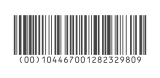
SSCC-18 barcodes represent Serial Shipping Container Codes. The symbology is a special case of GS1-128 with 00 as the application identifier.

Applications

  • Shipping containers

Also Known As

  • Serial Shipping Container Code

QR Codes

Anything a phone can scan.

Every smartphone reads QR Codes natively. Encode a URL, a phone number, a vCard, an App Store link, a Wi-Fi password, payment information – whatever fits as text. The 2D format that became the consumer-facing barcode.

QR Code

Quick Response Code

QR Code sample

QR Code is a 2D symbology used with barcode scanners and camera phones. This symbology is often used to encode text, URLs, telephone numbers, and contact information.

Applications

  • URLs
  • Bulk content

Also Known As

  • Quick Response Code

2D / Modern

2D barcodes for industrial and pharma.

Data Matrix and PDF417 pack a lot of data into a small physical space. Electronic-component marking, pharmaceutical unit packaging, transit tickets, ID cards, postal labels. New to Barcode Producer in version 26.

Data Matrix

ECC 200, ISO/IEC 16022

Data Matrix sample

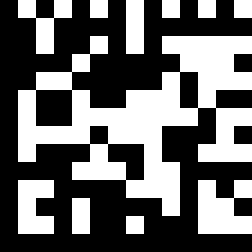
Data Matrix is a 2D matrix barcode that encodes alphanumeric data in a compact square or rectangle. It scans omnidirectionally and can fit a remarkable amount of information into a small physical space – up to 2,335 alphanumeric characters in a single symbol. The current version (ECC 200) uses Reed-Solomon error correction, which means even a substantially damaged or partially obscured Data Matrix code can still be read accurately. It's the modern workhorse of industrial marking, healthcare, and small-package identification.

NEW IN 26 — Data Matrix is new in Barcode Producer 26.

Applications

  • Industrial part marking — laser-etched directly onto components
  • Healthcare unit identification (FDA UDI compliance)
  • Pharmaceutical packaging (GS1 DataMatrix for regulated drugs)
  • Electronics manufacturing — PCBs and components
  • Small-format product labeling where a UPC or QR code won't fit
  • Document tracking and forms processing

Also Known As

  • ECC 200 (the current revision)
  • ISO/IEC 16022 (the international standard)
  • GS1 DataMatrix (the GS1-compliant variant used in retail and healthcare)

PDF417

Portable Data File 417, ISO/IEC 15438

PDF417 sample

PDF417 (Portable Data File 417) is a stacked linear 2D barcode capable of encoding up to about 1.1 kilobytes of data – significantly more than any 1D barcode and comparable to other 2D symbologies. Each PDF417 symbol is made up of stacked rows of mini-barcodes, which is why a printed PDF417 looks like a horizontal band of compressed bars. It was invented by Symbol Technologies in 1991 and is now standardized as ISO/IEC 15438. Despite the rise of QR Code and Data Matrix, PDF417 remains the format of choice for any application that needs to encode multiple discrete fields (name, date, address, ID number) inside a single readable symbol.

NEW IN 26 — PDF417 is new in Barcode Producer 26.

Applications

  • US driver's licenses and state-issued ID cards (AAMVA standard)
  • Airline boarding passes (IATA Bar Coded Boarding Pass)
  • UPS shipping labels (MaxiCode and PDF417 are both common on parcels)
  • Inventory and asset management
  • Government identification documents
  • Vehicle registration documents

Also Known As

  • Portable Data File 417
  • ISO/IEC 15438

Coupons & DataBar

GS1 coupons and the DataBar family.

Compact GS1 barcodes that carry more than just an identifier: expiration dates, weights, lot numbers, coupon offer codes. Seven DataBar variants cover everything from jewelry tags to fresh-produce labels, plus the GS1-128 Coupon for retail offers.

DataBar Expanded

RSS Expanded

DataBar Expanded sample

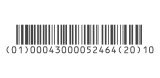
DataBar Expanded encodes a GTIN plus data such as expiration dates, weights, and lot numbers. It is intended for retail use, including coupons and variable measure products.

Applications

  • Product data
  • Some coupons

Also Known As

  • RSS Expanded

DataBar Expanded Stacked

RSS Expanded Stacked

DataBar Expanded Stacked sample

DataBar Expanded Stacked encodes a GTIN plus data such as expiration dates, weights, and lot numbers. It is intended for retail use, including coupons and variable measure products. DataBar Expanded Stacked is most popularly used as a part of coupons.

Applications

  • Product data
  • Part of product coupons

Also Known As

  • RSS Expanded Stacked

DataBar Limited

RSS Limited

DataBar Limited sample

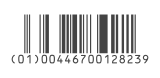
DataBar Limited encodes a 14-digit Global Trade Identification Number (GTIN). It is intended for use on very small items, must be read with a handheld scanner, and is not recommended for retail use.

Applications

  • Retail identification of very small items

Also Known As

  • RSS Limited

DataBar Omnidirectional

DataBar, RSS-14

DataBar Omnidirectional sample

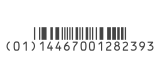
DataBar Omnidirectional encodes a 14-digit Global Trade Identification Number (GTIN). It is intended for retail use and is appropriate for smaller items such as jewelry and hardware products.

Applications

  • Retail identification of small or unusual items

Also Known As

  • DataBar
  • RSS-14

DataBar Stacked

RSS-14 Stacked

DataBar Stacked sample

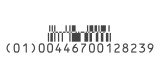
DataBar Stacked encodes a 14-digit Global Trade Identification Number (GTIN). It is intended for use on very small items, must be read with a handheld scanner, and is not recommended for retail use.

Applications

  • Retail identification of very small items

Also Known As

  • RSS-14 Stacked

DataBar Stacked Omnidirectional

RSS-14 Stacked Omnidirectional

DataBar Stacked Omnidirectional sample

DataBar Stacked Omnidirectional encodes a 14-digit Global Trade Identification Number (GTIN). It is intended for retail use and is appropriate for smaller items such as fresh produce and jewelry.

Applications

  • Retail identification of very small items
  • Fruit

Also Known As

  • RSS-14 Stacked Omnidirectional

DataBar Truncated

RSS-14 Truncated

DataBar Truncated sample

DataBar Truncated encodes a 14-digit Global Trade Identification Number (GTIN). It is intended for use on very small items, must be read with a handheld scanner, and is not recommended for retail use.

Applications

  • Retail identification of very small items

Also Known As

  • RSS-14 Truncated

Specialty

Industry-regulated identifiers.

Symbologies that carry identifiers regulated by a specific industry. UPC-A National Drug Code marks US pharmaceutical packaging with the FDA-registered NDC number.

UPC-A National Drug Code

UPC-A National Drug Code sample

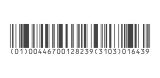
UPC-A National Drug Code (NDC) barcodes identify drugs in the United States. The symbology represents a drug's federally assigned National Drug Code, including labeler, product and packaging codes.

Applications

  • U.S. drugs

Barcode Index

Every name we know.

Every barcode in this guide — under its canonical name and under each trade, regional, or specification name it goes by. 61 entries.

Barcode Producer is for your Mac or PC. Enter your email and we'll send you a download link to use when you're back at your desk.

Send link
Account
Download Download Download Buy Now